
In government contracting, execution is not measured by effort. It is measured by outcomes.
Organizations often believe that strong teams and hard work are sufficient to deliver program success. While both are important, they are not enough. Without structured performance measurement, programs drift.
Earned Value Management (EVM) provides the control system required to prevent that drift.
What is Earned Value Management?
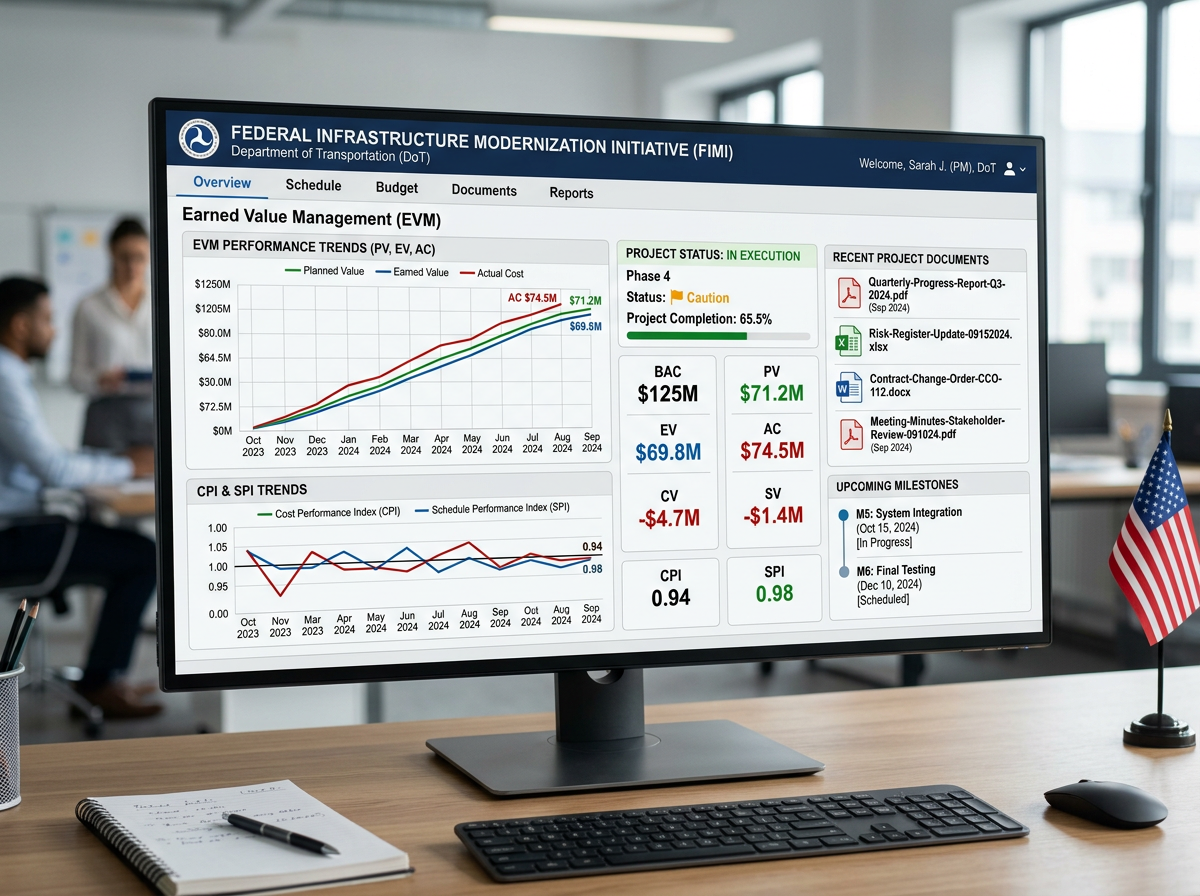
EVM is a performance measurement framework that integrates cost, schedule, and technical progress into a single system.
It answers three critical questions:
- Are we on schedule?
- Are we within budget?
- Are we delivering the expected value?
Without EVM, these questions are often answered subjectively. With EVM, they are answered with data.
Key Metrics: CPI and SPI
Two primary indicators drive EVM analysis:
Cost Performance Index (CPI)
Measures cost efficiency. A CPI below 1.0 indicates cost overrun.
Schedule Performance Index (SPI)
Measures schedule efficiency. An SPI below 1.0 indicates delays.
These metrics provide immediate visibility into program performance.
The Importance of the Baseline
EVM begins with the Performance Measurement Baseline (PMB). This baseline integrates the Statement of Work with time-phased budgets.
It serves as the single source of truth.
Without a defined baseline, performance cannot be measured accurately. Without accurate measurement, control is impossible.
Moving from Observation to Control
Many organizations collect performance data but fail to act on it. This results in observation without intervention.
Effective program management requires defined thresholds. When metrics exceed acceptable limits, corrective action must be triggered automatically.
This is the difference between monitoring a program and controlling it.
The “Truth-First” Reporting Standard
Accurate reporting is essential. Delayed or filtered information reduces the ability to respond effectively.
High-performing organizations operate under a “Truth-First” mandate. Data is reported as it exists, without delay or interpretation.
This transparency enables leadership to act before issues escalate.
Final Thoughts
EVM is not a reporting tool. It is a control system.
Organizations that implement EVM correctly gain visibility, predictability, and control. Those that do not rely on intuition and react after problems emerge.
In high-stakes environments, reactive management is not sufficient.
Execution must be governed.